Afro-Latin Caribbean Percussion Rhythms-
a Sneak Peek Behind the Scenes
by Goran Rista
The Afro-Latin Caribbean Percussion MIDI collection (the largest ever made) for Handy Drums: Latin Percussion & Drums is upon us. With this MIDI collection and our drum plugin, you’ll be able to play almost any Latin style.
Watch the video below to see what to expect, why it took several years to put it together, hear some of the included styles, and see what’s new in the upcoming Handy Drums Latin Percussion & Drums plugin v2.2 update. After watching, scroll down for more notes.
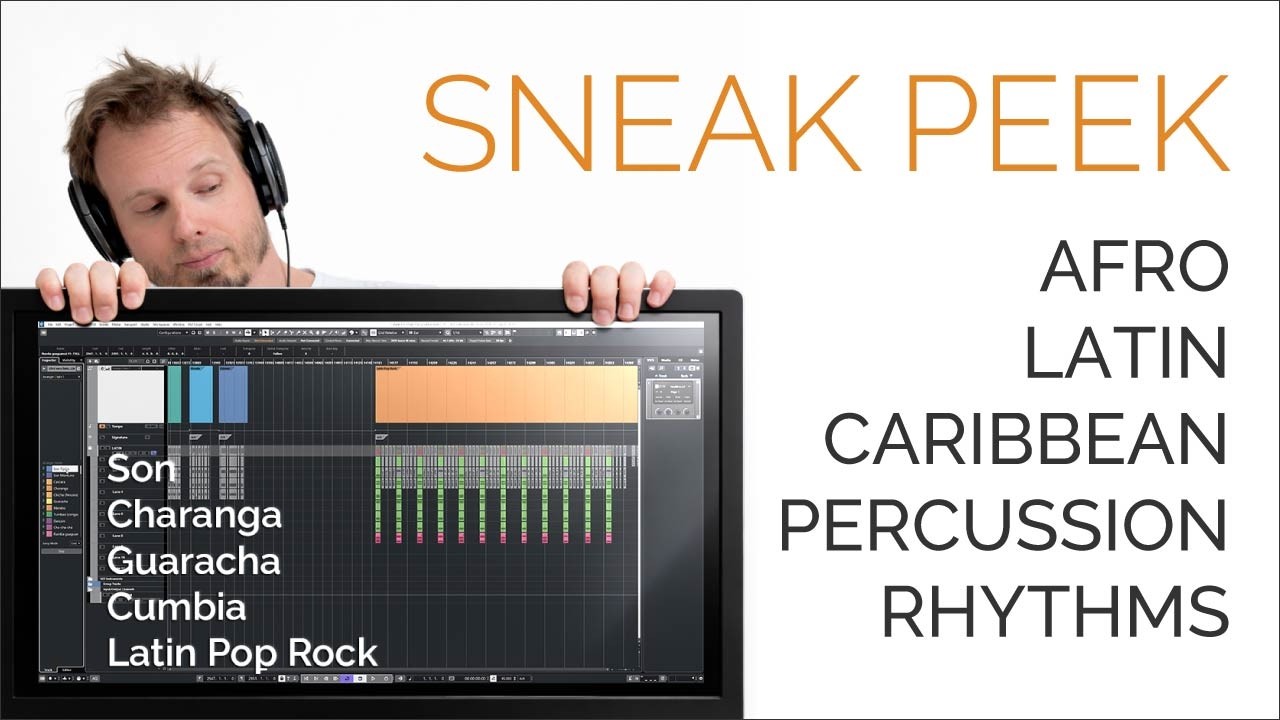

Ever since I published the default content for BeatBuddy over a decade ago, I have been getting requests for various Latin beats.
As I created some of them when producing that “default content”, I knew the task at hand. I knew that there were many styles out there and that to do a comprehensive, authentic MIDI loop pack, it would require significant time investment. Dedicating to such a commitment would mean putting the production and development of most of our MIDI content, sample libraries, and drum plugins on hold for quite a while.
That wasn’t a good business choice, so the Latin MIDI loops had to wait instead.
But, eventually, they needed to happen. So, here we are…almost!
It took years to produce this Latin Percussion MIDI collection. Here’s why.
Producing percussion MIDI content is significantly more time-intensive and challenging than producing standard drumset loops.
With standard drumset loops, I can either sit at an electronic kit and play-in drum groove variations and fills, or, when programming them, I can duplicate certain parts (like the hi-hat and snare) while only programming kick variations, thereby creating unique grooves.
When it comes to percussion grooves, things are a lot more complex. Since percussion grooves tend to contain several percussion instruments, each played by a different person, recreating those rhythms requires that each instrument part be created one by one.
To complicate things further, unlike creating original percussion grooves, producing percussion grooves in existing styles (like Son, Charanga, Cumbia, etc.) requires faithfully recreating each percussion part, along with its rhythm, accents, dynamics, and feel.
So, to accomplish that task, I had to conduct extensive research into many styles and instrumental parts. I went through several books, cover to cover, and programmed notated parts. I watched countless how-to videos for specific instrument parts, listened to recordings, and tried to get my hands on whatever I could for a given style, to get a good grip on the approach and authentic sound.
And if you’ve ever tried deciphering individual instrument parts from a percussion section, you know how incredibly challenging it can be.
When programming percussion parts, I not only painstakingly adjusted the articulations of every note, but also the timing. I created a groove template from an authentic salsa recording and applied the authentic feel to MIDI parts throughout the collection.
When it came to fills and breaks (unisons), I played them all in. Then I would go and tweak the timing, notes, and articulations where needed.
Producing this collection, given the number of genres covered, the required authenticity, and the variety, demanded enormous patience, attention to detail, and perseverance. That is why this will be a one-of-a-kind MIDI collection when released.
My Background In Afro-Latin and Caribbean Music
I’ve been exposed to Afro-Cuban, Latin, and Brazilian music in one form or another, listening to, studying, and playing it for about 3 decades now.
As a part of my Jazz degree in drums, I also studied Afro-Latin and Brazilian percussion and drums. While I do not primarily consider myself a percussionist, I have played both drums and percussion over the years in many Latin genres.
I spent a few years cruising the Caribbean, playing music on cruise ships, and lived in Puerto Rico for 6 months, regularly immersing myself in the local music scene.
As I’ve been living in Miami, Florida, for the past 20 years and have been married to a Puerto Rican woman all that time, this music has become second nature to me.
So, when I talk about “research”, it is not from the standpoint of a clueless beginner in these music genres, but rather as someone very familiar with the sound, feel, and musical language, looking to gain deeper knowledge of genre-specificities.
What To Expect and When
I waited until I finished all of the content and exported it into individual MIDI files to put together the “Sneak Peek” video above.
The list of styles is lengthy, with over 60. Each genre includes groove variations, fills, and breaks (with some exceptions). There are over 3,000 grooves, fills, and breaks.
All multi-part grooves will be provided both as full percussion ensemble (all instrument parts in a single MIDI file), and as separate instrument MIDI files.
All fills will be provided as a full percussion ensemble (with the main instrument playing the fill and the rest playing the groove) and as separate MIDI files for the improv instrument and the backing groove.
Breaks will be provided as single full MIDI files containing all percussion instruments, played in unison.
There are many moving parts when we release a new product, and getting everything in a row requires time and attention to detail.
We hope that over the next week or so, everything will be ready and released. We’ll first release the MIDI loops and the plugin update for DAW users, and after the dust settles, I’ll work on the BeatBuddy version and everything connected to it.
We’ll send out an email when everything is released, so if you are not on our list, subscribe to be notified.